By Mi-Young Park, CEO and Co-Founder
After 1,100 flat-cell cycles, our first-generation structural module retained 83 percent capacity. At the same cycle count under combined bending and compression, retention fell to 71 percent. The 12-point difference was not a manufacturing defect or chemistry problem. It exposed a testing-method problem: a flat fixture measures chemistry performance, while a combined-load fixture shows what the integrated structure can deliver in a vehicle.
What Flat-Cell Tests Capture and Miss
Standard lithium-ion cycle life tests follow protocols such as IEC 62660-1 or the USABC test manual. The cell remains flat under uniform contact pressure and cycles at a defined C-rate, typically 0.5C charge and 1C discharge, between voltage cutoffs. Capacity is measured at regular intervals. This keeps electrode geometry fixed throughout testing: there is no swelling, bending, or pressure difference across the cell face.
That setup is appropriate for characterizing chemistry. Flat-cell tests isolate mechanisms including lithium plating at the anode, SEI growth, and cathode particle cracking during repeated lithiation. They produce repeatable, comparable values for cell chemistry comparisons. For a conventional cell in a conventional pack, with a rigid housing maintaining uniform contact pressure, the result is a useful field-life predictor.
A structural cell laminated into a carbon-fiber composite member operates differently. The member bends under load, the electrodes deform, and contact pressure between electrode layers varies over the cell face. Areas under greater compression cycle differently from areas under tension. Flat-cell data has no measure for these effects. Applying it directly to structural designs can materially overestimate field cycle life.
Failure Modes Under Combined Load
Three failure modes can develop in structural cells under combined load without appearing in flat-cell tests at the same cycle count. First, interlayer delamination forms at the electrode-to-CFC bond interface. Repeated bending builds peel stress and microcracks at the interface, eventually separating the active electrode layer from the fiber ply. Parts of the electrode become electrically isolated, producing a step in capacity rather than the gradual fade associated with flat-cell aging.
The second mode is electrode cracking at the outer bend radius. In a highly curved member, electrodes on the tension side of the neutral axis experience tensile strain that fractures the coating around particles. Broken cathode particles lose electrical contact, permanently removing active material from capacity. Electrochemical impedance spectroscopy (EIS) can show this through higher high-frequency impedance before coulombic efficiency alone detects capacity fade.
The third mode involves electrolyte entering fiber voids. Cyclic bending can slightly open pores in the fiber-epoxy matrix that were sealed during initial consolidation. When electrolyte moves into those pores, less remains available for ionic transport, raising internal resistance over time. The effect depends on geometry and strongly on composite consolidation quality.
Our Combined-Load Test Protocol
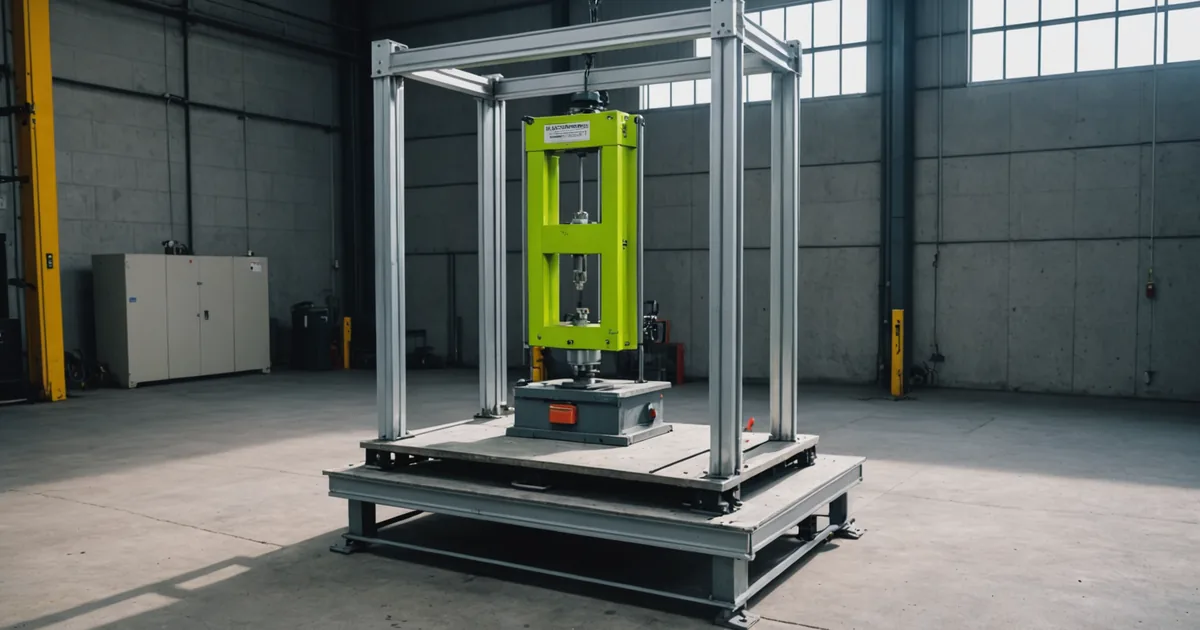
Our protocol applies electrochemical cycling and mechanical loading at the same time. A servo actuator drives the cell module in a four-point bending fixture. The load is a sinusoidal waveform at 1 Hz, with a peak bending moment of 200 N-m per meter of span. This matches the 80th percentile road load case for an EV floor panel under combined cornering and bump inputs, based on published proving ground datasets.
Electrochemical cycling uses 0.5C charge, CC-CV with a cutoff current of C/20, and 1C discharge. Each cycle includes a 15-minute rest at the top and bottom. Mechanical and electrical cycles operate independently in phase and frequency, which better reflects field conditions than synchronized cycling. Every 10th cycle, we measure capacity with a reference performance test (RPT) at C/5 in the flat position, avoiding bending offset in the measurement.
For a new cell design, the matrix uses three parallel specimens for each layup variant. We test three structural span lengths: 150 mm, 250 mm, and 400 mm. This characterizes geometry-dependent life and produces a failure model an OEM can apply to its structural geometry without a full bespoke test.
Decision Gates at 200, 500, and 1000 Cycles
The combined-load test has three formal decision gates. At 200 cycles, we look for early delamination: capacity retention must exceed 96 percent, while EIS high-frequency resistance must rise no more than 8 percent from its initial value. Cells below the 200-cycle gate are rejected. The cause is usually bond-interface preparation rather than chemistry, so changing surface treatment can resolve it without redesigning the electrode stack.
At 500 cycles, we screen for initial electrode cracking. Capacity retention must exceed 92 percent, EIS high-frequency resistance must remain below 115 percent of initial, and differential voltage analysis (dV/dQ) must not show the kink associated with cathode particle fragmentation. With our current dataset of 14 completed test runs, the 500-cycle gate predicts performance at 1500 to 2000 cycles with reasonable accuracy.
At 1000 cycles, we estimate end of life by linearly extending the capacity-fade rate from cycles 500 to 1000. The estimate is corrected for the nonlinearity that appears during the final 20 percent of capacity before the 80 percent end-of-life threshold. For our current cell generation, the projection has an uncertainty band of plus or minus 150 cycles at the 80 percent threshold. We are working to narrow it by characterizing late-life acceleration more closely.
What This Protocol Cannot Tell You
Combined-load testing at 1 Hz bending and standard electrochemical rates does not reproduce high-rate charging heat in a real vehicle, vibration fatigue from road use, or behavior under changing load amplitude. Each requires separate characterization. This is a screening tool, not a complete qualification standard. An OEM certifying a structural battery floor panel for production still needs environmental, vibration, and abuse testing beyond this dataset.
This does not mean flat-cell cycle life is irrelevant. It remains the strongest predictor of chemistry-driven degradation and the proper basis for comparing formulations. Combined-load testing adds structural degradation to that chemistry baseline. A cell with poor flat-cell life will fail sooner under combined load, while a cell with good flat-cell life may still fail under structural loading if electrode adhesion or composite integration is poor. Both measurements are required; neither is sufficient alone.